
We are ready to launch into our first growth phase, don't miss out on the opportunities!
02
Comparison to other Construction Methods

Traditional Wood Framed Construction:


A lot of tools are needed for the job...
Requires skilled labor and tight quality control, not to mention protection during a storm!
Blu coated wood is expensive, and all field cut ends must be treated.
At the end of the day it's still wood!
Humans are not perfect, they make mistakes!
No matter how you frame the debate over Green and Sustainable wood framed construction, mistakes will end up at the landfill!
Linked research or Published Articles:

A certain amount of lumber arrives from the lumber yard with black mold and can remain dormant within the wall, floor or roof cavity; if the lumber gets wet again either during construction or from plumbing leaks, the lumber mold can be re-activated.....then what?


Termites, worms, spiders, and insects of all types love wood for breakfast, lunch and dinner!
Traditional Light Gauge Steel Framed Construction:


New strict energy laws in the U.S. are re-defining the way a wood framed building envelope assembly meets code!
The standard R-value for batt insulation in a typical 2x4 wall has been reduced and now takes into account the actual studs, resulting in a reduction in R-Value. Builders are now faced with costly trade offs which inevitably lead to this costly example using a layer of foam insulation placed over the building paper to make up for the loss of energy at the studs. This method requires additional consideration for window and door transitions, and may lead to other problems such as water intrusion.
Although there is a lot less waste using metal framing, you will still end up with extra material. Do you store it? or do you send it to the landfill?
Light gauge metal framing is a clean construction methodology that requires skilled commercial framing sub-contractors and most likely union carpenters. The challenge does not stop there, the metal studs are a big thermal bridge. I think you know what happens when a cold surface meets a warm surface!
Here is one solution, adding a layer of foam insulation sheathing over the studs to reduce the thermal bridge, however the typical home builder may not fully realize the optimum location for the building paper and flashing. An experienced Architect should be closely involved!
Just about everyone you talk to these days is looking for a better alternative to traditional wood framed construction. Here are a few reminders of why other building methodologies are gaining market share and acceptance over wood framing.
GloPac has prepared a summary of different building methodologies, provided photos, and our comments as a reminder why the ReZist-It system is the best choice. GloPac's management has experienced decades of construction challenges first hand and has seen hundreds of constructions sites through-out the United States and in many parts of the world. These are a few of our observations!
After you review the various methods, you will find at the bottom of this section more information about the ReZist-It system.
Another solution, adding foam insulation is set in between the studs to reduce the thermal bridge, although not very effective the builder will get clever and expand the foam thickness beyond the metal studs; however this creates another challenge of attaching materials and building paper. This entire method is most likely performed in a controlled factory environment and requires long wall sections which must be delivered and then craned into place. This method inevitably results in costly design and delivery challenges.
Manufactured Modular Home Construction


Modular home construction is typically a "just in time" manufacturing business with a few repetative components produced for a small inventory. This type of business requires an enourmous building found in an industrial area near a port or rail and is probably and old energy hog. Any idle time will be very costly and passed onto to you the customer.
The typical modular home may travel over a hundred miles to its destination. A path of travel study will be an added cost, and don't be surprised when you here the news that numerous trees will need to trimmed or cut down, power lines raised, and mail boxes removed. You will most likely have to talk to your neighbors about trimming or removing their trees, disrupting their power or temporarily removing their mailbox!


You should plan for the unexpected, these types of situations happen more often than you may realize when you up against the clock!


So your modular home parts have managed to reach your site in one piece, and after being shaken around like it has been through dozens of small earthquakes its time to lift it into place. Are you sure your neighbors don't need to use the street for the better part of a day? Do you have room on your site for these massive cranes? Are you sure these massive crane trucks can actually reach your site, and without damage to your driveway or access road? Does your builder have a contingency plan for the rain? Remember it's wood (a food source for mold) and your factory built home probably arrived with interior materials that are not water resistant.
Wood SIP (Structural Insulated Panel) Construction
Alternative SIP Construction
The Patented ReZist-It System (It's a classification all by its self)
Cement Block Construction
The inherant problem with this methodology is found in the title, IT'S WOOD!
The only professionals that really like wood framed construction are the Attorneys.
Here is an easy to follow equation to remind you why nearly every Contractor these days is looking for an alternative to wood construction:
Wood =
Skilled Labor + (Nails + screws + Glue) + Wood Splines = Quality Control = Deadlines = Triple Constraints (time-scope-budget) = Shortcuts = Air leakage = Vapor & Water Intrusion = Mold + Dry Rot =
Sick Buildings = $ Costly Repairs $
Costly Repairs = Higher Insurance Costs = Finance Challenges


Transporting these panels are a big challenge. The panel edges can easily become chipped and broken, then what? This is a common reason for unintended vapor transmission and mold at the panel joints
Does your builder have a contingency for rain? They say that O.S.B. is capabale of getting wet without damage! Have you ever seen what happens to the edges of O.S.B. when it gets wet- it swells up, and does not contract.
Please refer to the equation above!
Please refer to the ReZist-It system!
(Left) Here is an attempt at the problem. A cam lock device is used to pull the panels together, the board is held back, and the edges are concealed with more wood. This method is used in the refrigeration industry where metal skins are used. The home building construction environment is much different and trying to get the panels aligned and the cam locks applied is extremely difficult.
The foam edges are sometimes scooped out in the field by a hot knife to accomodate the wood splines.
See the equation above!
If you had a choice between a panelized wood system or a highly efficient NON-WOOD system, which would you choose?
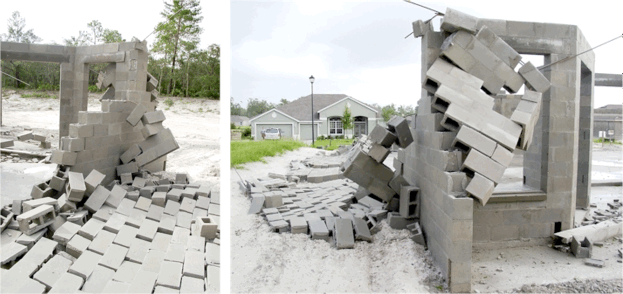
A modern masonry wall can be reinforced both horizontally and vertically. Reinforcement is usually required in both load-bearing and nonload-bearing walls.
(see photo above) Enough said!


It's no secret that living in a home built with cement block walls in the United States is a constant battle between being too hot or too cold.
Too hot:
Cement block walls are excellent at retaining heat in the daytime and dissipating the heat inward when the sun goes down and you arrive home from your daily activities! So, just turn on the fans, open the windows, but now your too cold!
Too cold:
Cement block walls have virtually no insulation value what so ever, so if you live in a cold climate what do you do? Turn up the heater and watch the condensation start to form? No, you need to design your home with insulation, but if you are not carefull you will find out that mold will form and grow where the cold surface meets the warm surface.
These same challenges can be found in a home built with concrete panels
Cement block walls have different perm rating than drywall, wood, or the various types of batt or rigid insulation. Water vapor travels at different rates through these materials and when the vapor travels from an area of high to low concentration this moisture can be trapped between the material layers and lead to decay and mold growth. It is nearly impossible to properly control this vapor transmission when you have so many different materials to deal with unless you have a good ventilation system running constantly. This may be common practice in commercial buildings but it's not at all practical in the average home.
So you need insulation, and your not crazy about seeing the electrical conduits and junction boxes, here is the most practical solution-
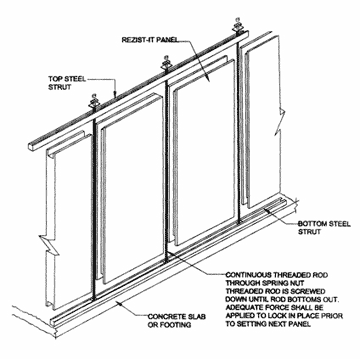


The ReZist-It system contains no wood!
The ReZist-It system contains no food source for mold to thrive!
No other system or construction methodolgy has sucessfully used MGO board (or even fiber cement board) in a panel system- Why?
- Because they need to use nails or screws to attach and connect the panels into the splines.
- The edge nailing requirements are too difficult to achieve.
- The board edges are usually damaged during transport or when moved into place.
- And the board edges break apart from the impact of the hammer, or even the screw gun.
- The ReZist-It system does not use nails or screws.
The ReZist-It system uses a Magnesium Oxy-Phosphate (MGO) cement type sheathing on both faces. Magnesia cement board was approved for construction in the U.S. around 2003 and is now A.S.T.M. approved.
Click here for additional facts.
The ReZist-It system uses light gauge steel to surround and encapsulate the foam core, this solves many problems:
- The foam core is completely protected from termites and insect infestation.
- The panel edges are protected from major damage during transport and construction.
- When a closed cell polyurethane foam core is used, the maximum R-Value remains because the panel board and metal edges completely encapsulates the foam core and contains the trapped insulating air within the foam cells.
This photo (above) shows a cut away section of the ReZist-It panel. We use both injected and rigid closed cell polyurethane foam core, and rigid EPS foam core in certain regions only. Our closed cell polyurethane foam achieves the highest R-value per inch at of all the insulation products available today.
Wood SIP's should not use closed cell polyurethane because that system has wood, drywall and building paper components and needs to breath throughout the assembly. Wood SIP's primarily use EPS foam which has about half the R-value per inch, and therfore needs a much thicker panels to achieve the same R-value that the ReZist-It panel achieves in our 4-1/2'' thickness.
We continue to improve our panel quality and have recently developed new technology that eliminates the clinching marks on the the metal corners; Our Patented inverted hat channel now has smooth and continuous metal corners all around.
The system is also designed so that no metal is ever exposed to the outside (or inside) elements!
The system is designed to conceal, protect and fully insulate all structural componets including our top and bottom strut tracks, vertical threaded tie rods, and metal hat channel frame.

The ReZist-It system does not require an enormous building to manufacture it's products. It does not require 30 foot high ceilings requiring massive amounts of energy.
Our inventory is disbursed throught-out our ReZist-It Marketplace retail centers. Any idle time in the factory does not translate into huge overhead costs and therefore this translates into savings to you the customer!
Our panels are neatly packed and tighly secured with our rod and strut system, The edges are protected from strap damage commonly found with other materials and systems.
When the panels are lifted off the truck, the panels can be easily maneuvered onto the site.
(Left) We continue to improve our panel quality and have recently developed new methods to achieve consistent panel thickness, and square panels with high volume output. This quality is nearly impossible to achieve on the job site.
Panels are bundled and ready for unpacking and lifting into place.


Here is one perfectly good example of someone's great intentions to break through the traditional Wood SIP methodology and replace the Oriented Strand Board with a fiber cement board.
Unfortunately this attempt went horribly wrong!
(Photo right) When you see a job site with a pile of foam and cement board debris like this one, and you know that the panels were manufactured off site, in a controlled environment you start to wonder?
(Photo left) When you arrive at a job site and see this pile of panels you don't need to look much further to realize there are major challenges ahead.
You simply cannot transport SIP's when the board is hanging over the edge, especially when your using a cement fiberboard. Now lets say you decide to place the splines around the edges and keep them in place (from the factory) until the panels are lifted into place; Unfortunately there is no practical way to achieve this, but lets say you found a way, you still have to lift the panel over the bottom plate and maneuver it with precision to avoid damage to the edge. Good luck!
(Photo left) When you see walls that don't fit, you start to wonder?
(Photo right) From a distance it actually looks pretty good!
(Photo left) When you look closer you begin to see why this Alternative SIP simply had no chance to suceed!
When these two panels were joined with a combination of screws and nails they realized that the tight nail spacing required by code could not be achieved within 3/4'' from the edges because the fiber cement board is much too brittle, so they needed to add multiple studs to move the nailing further away from the edges.
You also need to make sure the nails or screws are not over driven!
(Photo right) When you have panel edges that are already broken, or about to break off you realize your have an impossible task as a carpenter, so you just leave it like this and let the plasterer try to cover up the sins.
(Photo left) So your the guys who have to install the windows, what do you do?
Or your the Plaster Sub Contractor?
The trained eye can always spot a building that got hit with a rain storm during construction and used O.S.B. sheathing under the plaster finish, by the bulges at the panel joints; Or a floor finish laid over an O.S.B. floor sheathing. . Don't be surprised if you see someone grinding away at these edges to try and mitigate the damage. The inspectors hate when you do that because you just compromised the edge nailing strength. The joints can also expand from moisture traveling through improperly sealed panel joints.
Here are some important articles written by experts on the subject of panelized construction methodologies worth reading to get a full perspective and understanding of how our technology fits into the big picture.
Links:
huduser.org/portal/publications/Res_panals_benchmark_requirements.pdf (see page 87 for the ReZist-It system mentioned in our earliest stages of research and development)
www.fas.org/programs/energy/btech/about/Cementitious%20Structural%20Insulated%20Panels%20Demos.pdf
www.fas.org/programs/energy/btech/advanced%20technologies/About%20SIPs%20and%20CSIPs.pdf
Don't miss our testing data by Intertek

(Photo below) Pre-cut foam inserts are easily applied onsite to surround the threaded rods and insulate the metal hat channel. When the panels are joined together by the top and bottom struts, and the panels are drawn together, a tight, clean and even joint is created. The metal is designed to sit back from the panel faces by approximately 1/8'' creating the perfect reveal for our vapor stop sealant, and also the ideal design for eliminating the common thermal bridging found in other systems.
(above) The ReZist-It panels are designed to accommodate electrical wiring with pre-cut horizontal chases and a natural vertical chase created by the unique hat channel design.
Since the typical panel using polyurethane foam achieves an R-28 insulation value in 4-1/2'' which is approximately half the thickness of the typical wood SIP with the same R-value. This advantage allows the Architect to create a double wall on the exterior to accommodate plumbing water lines and drains. We believe that plumbing lines should not be crammed into the typical exterior wall with little insulation protection., it's just not worth the risk!
(Photo left) This home was built with ReZist-It exterior and interior walls and a traditional wood trussed roof. Our system is designed to adapt to these conventional methods with ease and strength.
We also have pre-designed kits which use the ReZist-It roof panels. Like any other type of SIP, our roof panels require careful design and planning, and are not suited for all home designs.
With some creativity, the ReZist-It panel system may be an ideal solution as a flat ceiling panel instead!

The finished product
Insulated Concrete Forms (ICF'S)

There are some distinct advantages using Insulated Concrete Forms (ICF’s) over the methods outlined above, which your Architect can discuss with you in detail. The disadvantages are some times overlooked for various reasons which you will have to take up with your Architect or Contractor.
Common problems you will hear:
- 5-10% more in cost than traditional wood frame
- Difficult to remodeI
- Requires skilled labor
- Inadequate and poorly assembled bracing
- Poorly assembled ICF block forms
- Blow-outs & Voids in Key Structural Points
- Grossly out-of-plumb & un-level walls
- Vast amounts of wasted materials and time
- Rust from drywall attachment screws
- Electrical conduit and junction boxes against a concrete surface (thermal bridge)
- The system is primarily only used for exterior walls, so you have not eliminated the need for a skilled wood framing crew.
- The interlocking edges of the panels or blocks are points where water can penetrate.
- Cold joints created between concrete pours are a likely point for vapor transmission if it's not properly sealed
WATERPROOFING ISSUES:
• The skin (polyethylene film) surface of the ICF is extremely difficult to adhere to, especially with construction dust that is usually present.
• The panels or blocks (ICF units) are often damaged during shipping or erection and must be patched prior to waterproofing.
• The ICF material and waterproofing can easily be damaged with the native backfill which is typically used.

(Photo right) Is a completed ICF project with the walls filled with concrete. There was without a doubt a huge challenge to brace these walls to prevent them from blowing out during the concrete pour.
Note that no interior walls are in place to allow room for access during the ICF install, shoring, and the concrete pour.
There is inevitably a huge pile of debris left over which end up in the local landfill.
(Photo left) This window opening had to require a great deal of skilled labor to complete; The top of the wall was designed on a slope which required precise field cuts, and notice the sliver of ICF above the wood frame, this required skilled labor and yet some patching still needed to be accomplished. This patch may leave a cold spot and a point for vapor transmission.


Top Ten Reasons Building Scientist Like SIPs
1. Panels are airtight and can be assembled into structures with little unintentional infiltration or exfiltration
2. No wall cavities
3. Air impermeable, solid and homogeneous insulation
4. Far fewer thermal bridges
5. Panels are bi-laterally symmetrical with respect to vapor permeance-appropriate for all climates
6. Easy to create conditioned attics (even with complex roof geometry)
7. Supports construction for extreme climate enclosures
8. High snow load areas have insulated overhangs
9. Hard to put plumbing and ductwork in exterior walls
10. Control of heat and air is easily done leaving more time to get the water and vapor control done right